Floor-preservation field note · 17 September 2026
Protect the Finish, Then Protect the Rolling Path
Last updated:
Start with the floor’s movement, not the mat listing
A chair mat for vinyl plank flooring needs a backing and material the flooring manufacturer permits. Avoid assuming that any hard floor mat is suitable, especially when backing additives or trapped debris could affect the finish. Measure the chair’s full rolling area and check edge height against nearby doors. Keep the floor and mat underside clean, and assess whether the mat lies flat without creating an awkward transition.
A useful starting point is to read office chair mat options for vinyl plank flooring protection as a shortlist of formats, then bring the choice back to the room. A broad clear mat can make sense when the chair has one stable home. A larger rectangle may be safer when the chair backs out from a desk. Neither description answers the important question: which surface is carrying the wheel when you lean, turn, or reach for a drawer?
That floor-first view also keeps expectations realistic. A mat can spread contact and intercept grit; it cannot repair an already loose seam, level a sun-faded patch, or make a rough caster gentle. The best setup is usually quiet enough that you stop noticing it. The chair rolls without a bump, the mat stays flat, and the plank surface is easy to inspect when you pull the chair away.
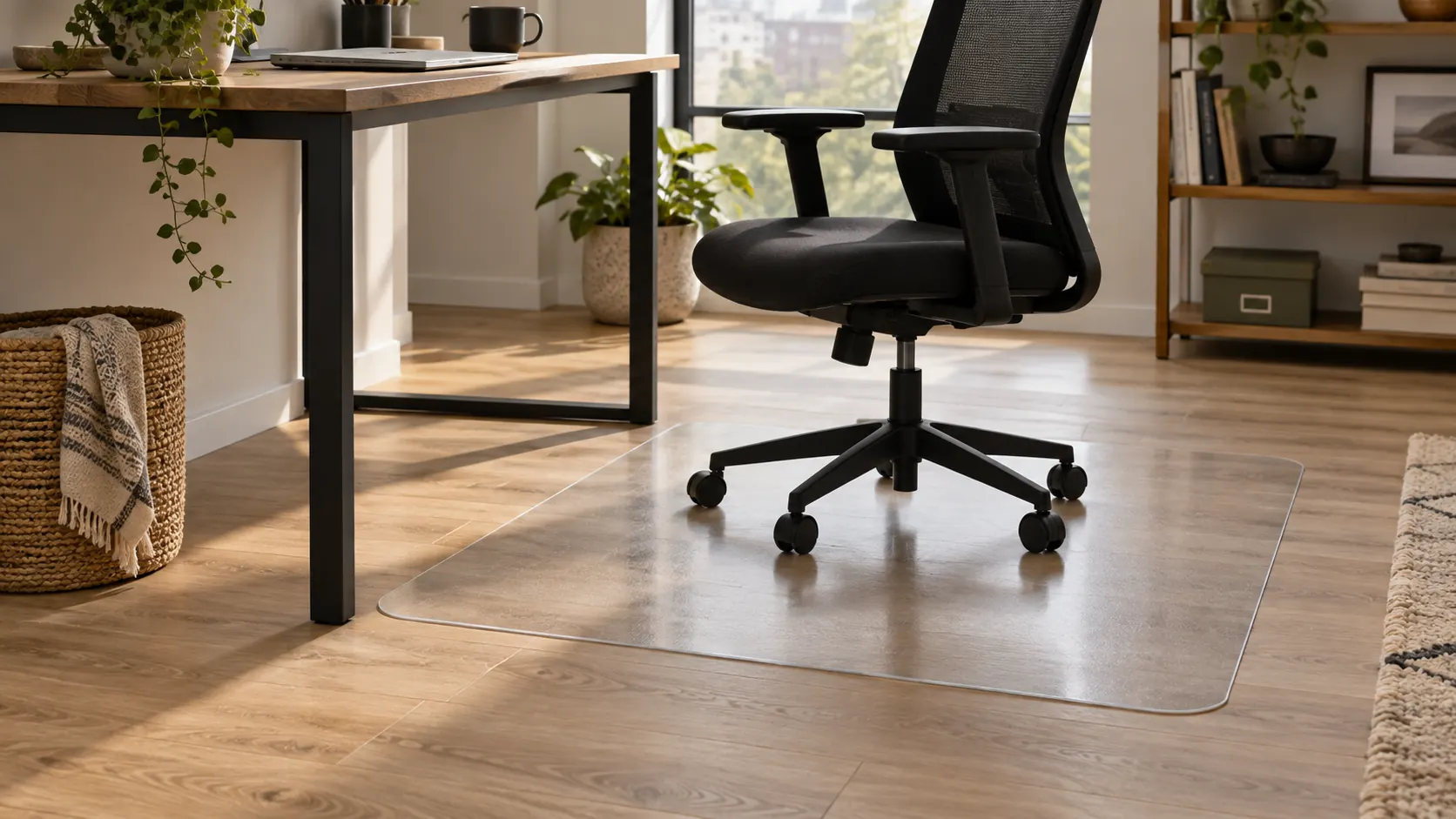
Find the actual rolling envelope
Desk dimensions are not a rolling-zone measurement. I tape a temporary rectangle around the chair, sit down, reach to the far corners of the work surface, swivel toward storage, and stand up as I normally would. The farthest wheel movement—not the footprint of the desk—is the useful boundary. In a compact room, an L-shaped path may matter more than a large centered rectangle because one drawer pull or printer shelf sends the chair diagonally across the planks.
Leave a little quiet floor beyond the active route rather than making every corner of the mat work as a stopping line. A caster that meets an edge while loaded can drag the mat, make a sharp sound, or encourage someone to force the chair across the transition. This is especially noticeable on floating floors, where a dramatic edge transition can feel like a fault even when the flooring itself is sound.
A simple paper map helps: mark the chair center, the usual feet position, storage reach, door swing, and any spot where a cable tugs. Then watch which marks form a loop. That loop, not an optimistic product diagram, is the area the mat must serve. It also shows when changing chair position or adding a small side table will solve more than buying a larger sheet of material.
Match material to the room’s behavior
Clear rigid mats keep the floor visible and make crumbs easy to see, but their feel depends on thickness, underside texture, and how flat the installation surface is. On a level vinyl plank area, a quality hard mat can provide a clean rolling plane. On a floor with small undulations, a too-rigid sheet can bridge a low point and create a rocking corner. That is a setup problem, not an invitation to wedge something underneath.
Tempered glass is a different category of decision. It has a smooth, stable rolling surface and a distinctive visual weight, yet it also changes the room’s sound, handling, and edge feel. A very heavy glass mat is not automatically kinder to vinyl plank; it still needs a clean interface and a placement plan. Soft mats can be useful for temporary stations, but they may compress under a loaded task chair and make effort, rather than protection, the dominant experience.
I avoid treating a chair mat as a finish because it is a working surface. The right choice should let you vacuum, inspect, and reset the area without drama. If the material makes you reluctant to lift it, clean under it, or move it during a room rearrangement, it is asking too much from an ordinary home office.
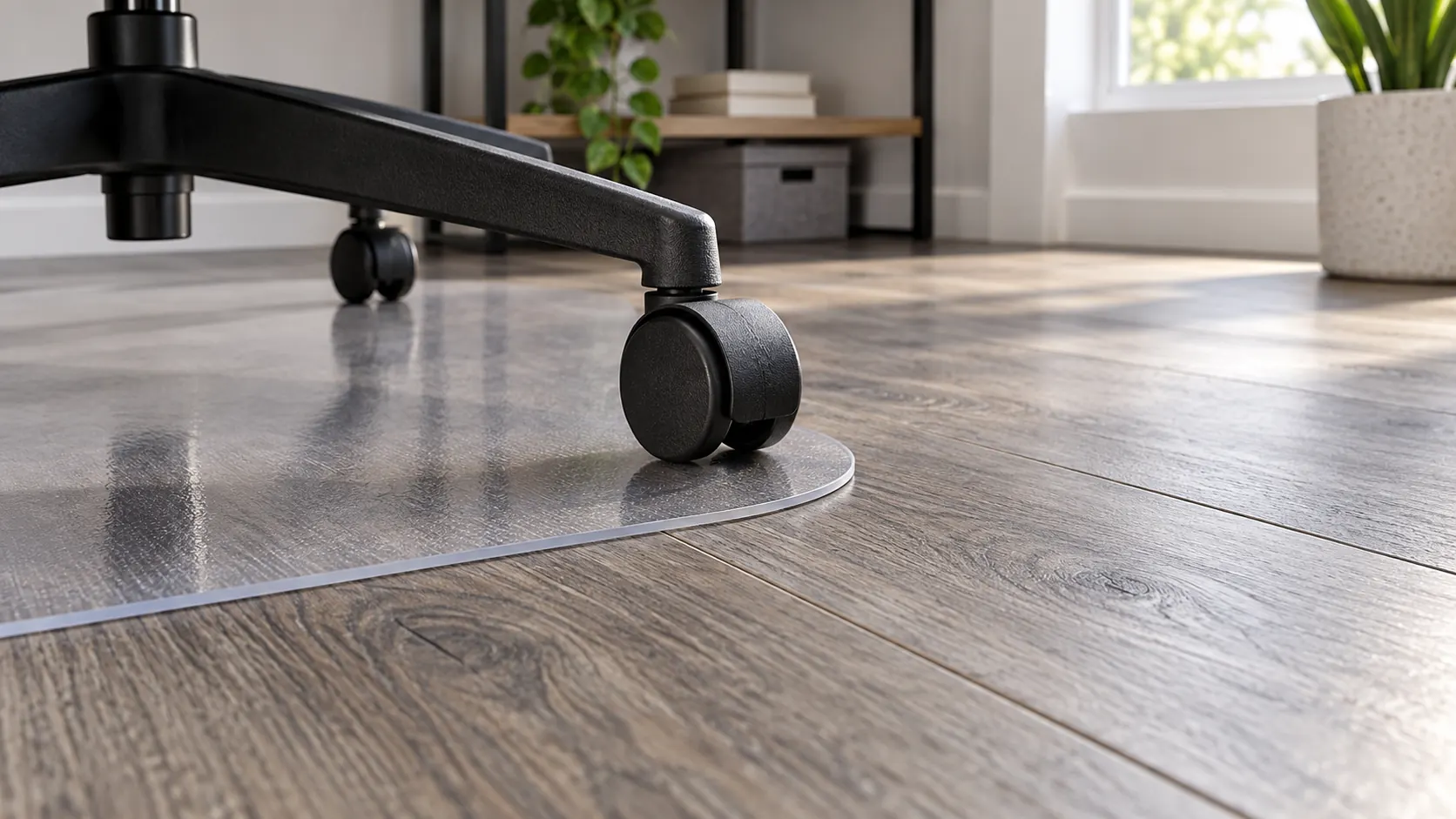
Give the wheels equal attention
A mat receives the force a caster delivers. Hard, damaged, or grit-packed wheels can make even a generous mat feel harsh at the margins. Turn the chair over and look for flattened treads, wrapped hair, embedded debris, and wheels that do not rotate freely. A wheel that skids rather than rolls concentrates friction in a way a mat cannot fully offset.
Soft dual-wheel casters are often a calmer pairing for finished hard floors, but material labels are not a substitute for observation. Roll the chair slowly across a clean test area, then turn it under normal seated weight. Listen for clicks and feel for resistance. If the chair wants to pivot on one stubborn wheel, correct that before judging the mat. The difference can be immediate and does not require making claims about a particular brand.
Check the chair after changing any part of the setup. A lower-friction surface may cause a familiar chair to travel farther than expected when you sit or stand. Adjust desk distance, cable slack, and the position of nearby furniture so the smoother roll becomes predictable instead of surprising.
Treat edges as transitions, not borders
Most complaints about chair mats are really complaints about transitions. The wheel crosses an edge while someone is reaching backward, the sheet lifts slightly, and a routine movement becomes a small interruption. Rounded corners, adequate thickness, and a mat that lies flat all help, but placement matters just as much. Keep the active work position well inside the perimeter whenever the room allows it.
Do not tape down a mat with an adhesive you have not cleared for the floor finish. Vinyl plank manufacturers vary, and a sticky residue can create a harder cleanup problem than a rolling mark. Instead, let a new mat acclimate flat in the room, clear dust beneath it, and confirm that it rests naturally. If it continues to curl or shift, reconsider the material or the geometry rather than adding an improvised restraint.
An edge check belongs in a regular reset. Roll out, roll back, look across the surface at a low angle, and notice whether a corner has begun to lift. Small changes are easier to correct before wheels repeatedly find the same raised point.
Build a cleaning rhythm around inspection
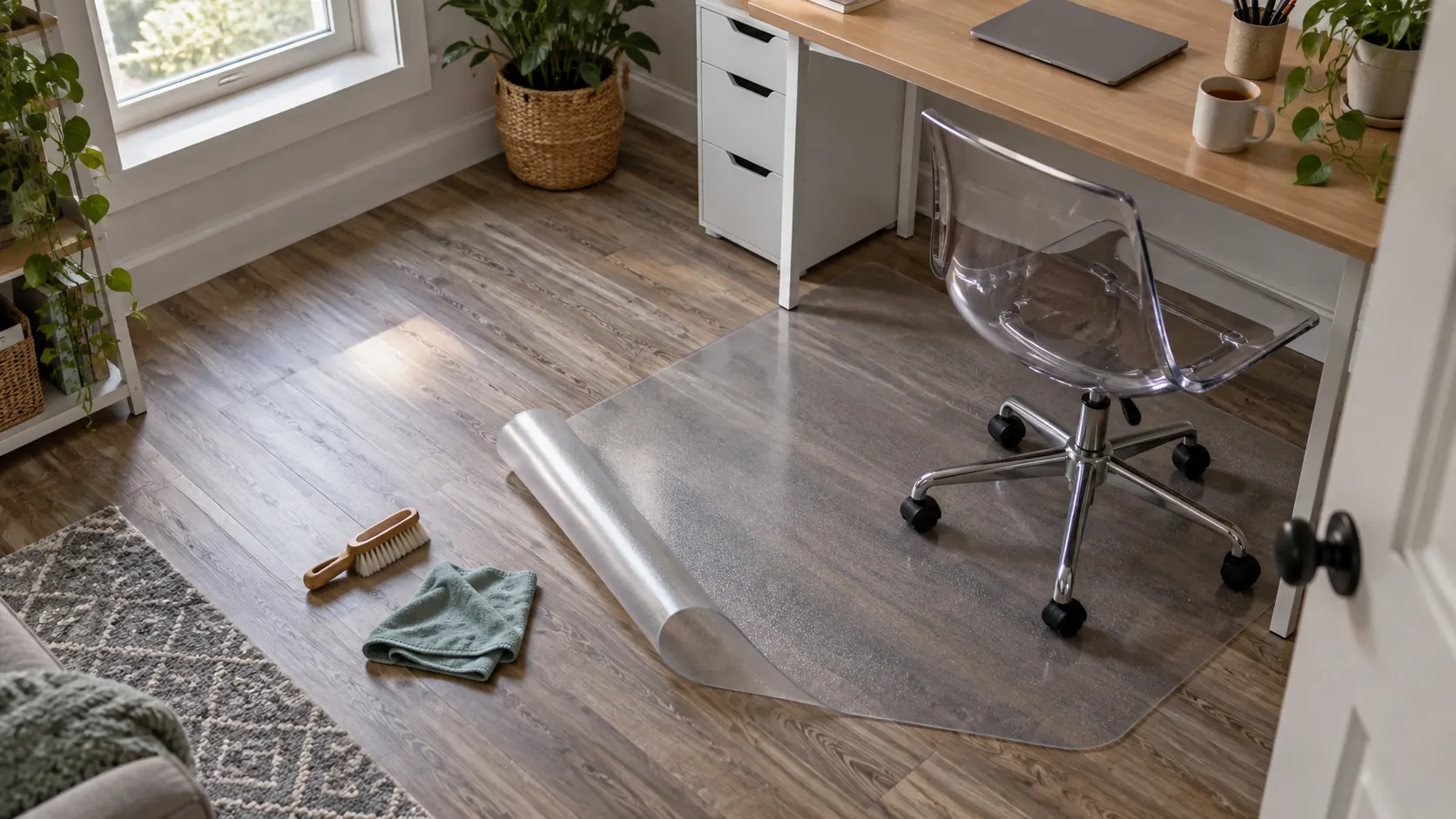
The invisible enemy under a chair mat is not the floor; it is the mixture of dust, grit, pet hair, and occasional moisture that can be trapped where you cannot see it. Lift or slide the mat periodically with another person if it is heavy, vacuum the exposed surface with an appropriate hard-floor setting, and wipe only as the flooring manufacturer allows. Let both surfaces dry before putting the mat back.
Avoid flooding the perimeter or using a harsh cleaner because a mat makes it tempting to assume the floor below is protected from every maintenance choice. The goal is modest: remove particles that act like abrasive paste, check for unusual marks, and restore a clean flat interface. A microfiber cloth, soft brush, and patient inspection usually accomplish more than a shelf of aggressive products.
Use the reset to record a change if you see one. A fresh scuff, a shifting seam, or a dull patch is useful information. It may point to a wheel, a chair habit, direct sunlight, or a pre-existing flooring condition. Naming the change prevents a mat from becoming a vague explanation for everything that happens nearby.
Make the final decision legible
A good purchase decision can be written in a few plain statements: this is the measured zone; these are the wheel conditions; this is the floor’s current state; and this material can be cleaned and removed without a special ritual. If any statement feels uncertain, pause there. Measurement and a short trial placement are cheaper than living with an edge you dislike every day.
For renters and shared households, reversibility deserves extra weight. Choose an arrangement you can inspect, lift, and explain to the next person using the desk. For a dedicated office, durability and a generous movement envelope may matter more. In both cases, the mat should support a habit of checking the flooring, not hide it indefinitely.
The calmest outcome is not a dramatic protective layer. It is a rolling path that fits the room, wheels that behave, edges that stay down, and vinyl plank that still looks like the floor you meant to keep visible.
A five-minute decision checklist
- I measured the furthest real wheel path, including drawer and exit movement.
- I checked caster tread, rotation, and debris before blaming the floor.
- I can keep loaded wheels away from the mat edge in normal use.
- I know how I will lift, clean, dry, and reset the area.
- I am choosing a reversible setup that fits this room rather than a generic diagram.
Comparison: what each choice asks of the room
| Approach | Useful when | Watch closely |
|---|---|---|
| Clear rigid mat | The floor is level and the rolling zone is stable. | Corner lift, low spots, and edge crossings. |
| Tempered glass mat | A fixed desk needs a firm smooth plane and handling is manageable. | Weight, sound, transition feel, and cleaning access. |
| Soft or flexible mat | The station is temporary or movement is light. | Compression, bunching, and increased push effort. |
| No mat plus improved casters | The chair moves lightly and the floor plan allows a low-friction solution. | Direct wheel behavior, grit, and manufacturer care guidance. |
A table cannot choose for a room, but it can make the trade-off visible: a mat is one part of a rolling system, not a separate piece of décor.
Before committing, I would spend one ordinary work session with the measured route in mind. Notice the chair’s quietest position, the turn that asks most from the wheels, and the spot where you naturally stand. That brief rehearsal anchors the decision in lived movement. It may confirm that a mat is appropriate, or it may show that a different caster, a cleaner perimeter, or a small furniture shift deserves attention first. Either answer protects the floor better than a purchase made from dimensions alone, a generic promise, or a promotional photograph.
Earlier in the independent publishing sequence
For context on the publishing sequence, open the preceding independent publication. This is a chronological reference, not a topically related recommendation or a claim that the preceding publication has completed its own backlink finalization.
Review Privacy for Your HP Display
Chair mat selection concerns floor contact, while display privacy is a different requirement. The next guide covers filters for HP Pavilion 15.6 inch touchscreens, with exact dimensions and touch compatibility to verify.