Room-use notebook · Issue 04
A portable laptop desk should make seated work easier to leave
Last updated:
A portable laptop desk for a couch or recliner needs to fit both the seat and the way you sit. Check the base footprint, underside clearance, surface angle, and how easily you can move it away before standing. Keep laptop ventilation unobstructed and drinks separate from electronics. Compare stability with your actual computer size, and avoid assuming a soft seat provides the same support as a conventional workstation.
A couch-side desk is easy to picture and harder to place. Product photos often crop out the footrest, the lamp cord, the pet path, and the few inches a person needs to get up without catching a shin. I begin with the room because the room supplies the constraints that a product listing cannot. The work surface matters, but its real job is to create a repeatable position for a laptop, a drink, and a small amount of attention without claiming the whole seating area.
The right choice is rarely the largest platform or the one with the longest list of adjustments. I prefer an arrangement that has a clear arrival routine, a stable working position, and a low-friction exit. That framing keeps the decision grounded: a desk can be portable, but it is not automatically safe beside every recliner or comfortable over every cushion. A few measurements and a short trial routine expose more than a dramatic before-and-after photo.
Begin with the chair, not the product photo
For a broad starting point, compare the practical buying factors in this portable laptop desk for couch and recliner use roundup before treating any individual feature as decisive. Measure the seated area beginning at the back cushion and ending at the front edge because a deep relaxed seat changes where knees and laptop corners land. Here, begin with the chair, not the product photo meets a distinct purpose: the useful desk is the one that supports a short focused session, then lets the room become a room again..
Record the outer arm-to-arm width, not only the open seat width, when a rolling or C-shaped base must pass beside upholstery. Leave a clear route from the seat to the floor so a reader can stand without lifting the desk or twisting around a wheel. Notice whether a recliner footrest changes the usable floor area when it opens, because the extended mechanism may enter the same zone as the base. Use painter’s tape or books to mark a tentative footprint before ordering; a ten-minute floor mock-up makes vague dimensions concrete.
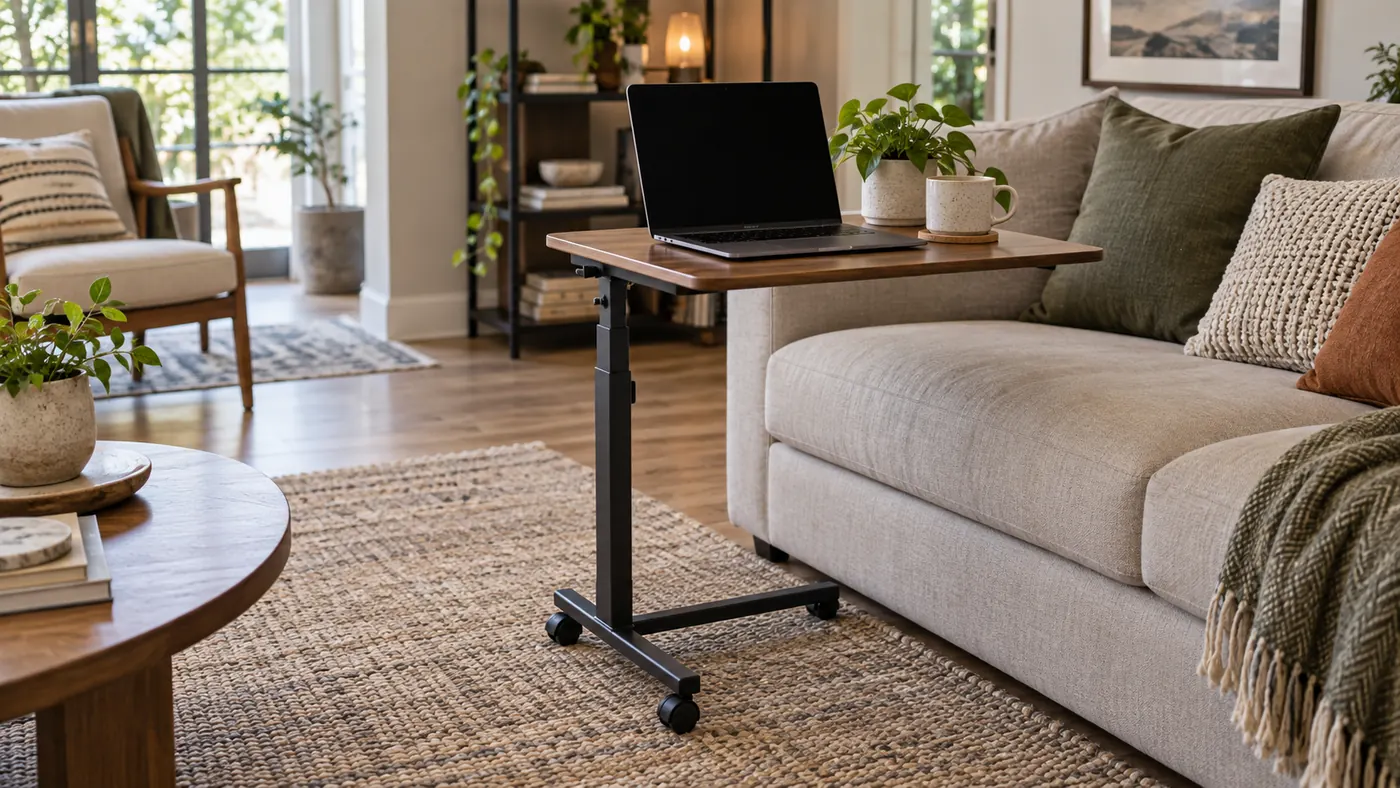
Choose a working zone with an exit route
Place the desk where its long edge serves the seated person without pointing a corner directly into the usual walk path. Keep lamps, side tables, pet beds, and charging outlets in the first sketch because these fixed objects decide whether a position is realistic. Here, choose a working zone with an exit route meets a distinct purpose: the useful desk is the one that supports a short focused session, then lets the room become a room again..
Test the route with empty hands and then with a mug in hand; an arrangement that only works when someone is careful is not a calm daily setup. Consider whether the desk must move for another household member, rather than assuming one person’s evening position can stay in place. Give the base a predictable resting line along a wall or rug edge so returning it does not become an improvised furniture shuffle. Treat a narrow passage as a reason to reduce the desk footprint, not as a reason to train everyone to step around an obstacle.
Compare the arrangement, not the sales language
| Question | Useful evidence | Warning sign |
|---|---|---|
| Will it fit? | Measured chair, arms, footrest and exit path | Only the top dimensions were compared |
| Will it stay calm? | Base and surface tested with real items | It needs constant bracing or a special load order |
| Will it leave? | Clear storage spot and cable reset | It stays open because putting it away is annoying |
Match surface size to the actual session
Start with the laptop footprint and the one accessory that genuinely stays out, usually a mouse, notebook, or charging brick. A wide surface can invite a pile of secondary objects that makes a small desk more awkward to carry and harder to clear. Here, match surface size to the actual session meets a distinct purpose: the useful desk is the one that supports a short focused session, then lets the room become a room again..
Check that the front edge does not press into the thighs when the screen is at the preferred distance, especially on low cushioned seating. Reserve some empty surface around a hot laptop so air can move and hands have an obvious place to hold the desk while repositioning it. If a mouse is essential, judge the usable flat area rather than the largest measurement in the specification sheet. Choose an edge stop or surface texture only when it solves a real sliding problem; extra hardware can interfere with wrists and storage.
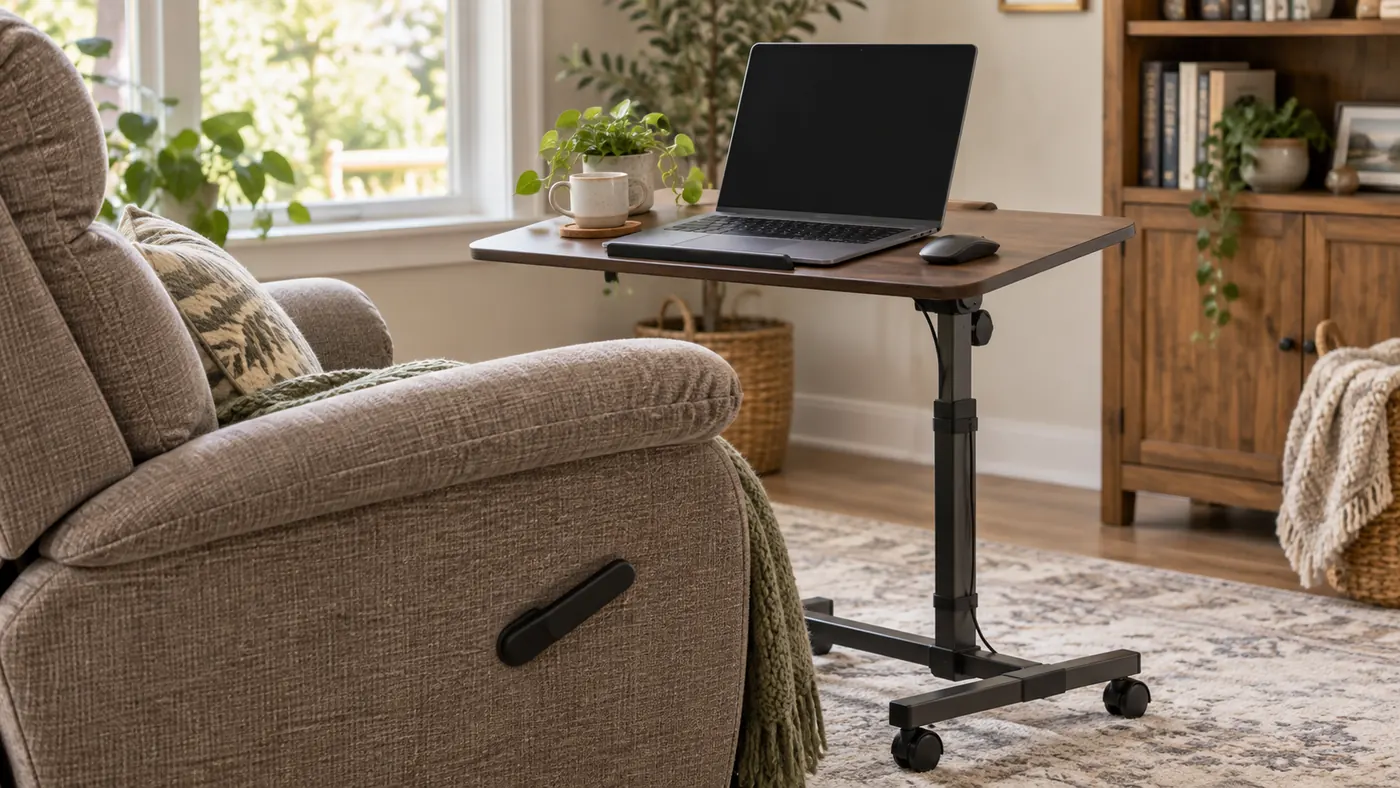
Ask the base to do the stabilizing
A desk that depends on a pillow, blanket, or shifting seat cushion for its level will change as the person relaxes into the furniture. Look at the connection between upright column and base before admiring a decorative top, because that junction carries the working load. Here, ask the base to do the stabilizing meets a distinct purpose: the useful desk is the one that supports a short focused session, then lets the room become a room again..
Roll or slide a candidate position slowly across the floor type in the room; thick rugs and uneven seams change how a base settles. Use a modest downward press at the outer edges during a home trial to reveal flex, wobble, and caster movement before a laptop is involved. Avoid placing a loaded desk where a reclining mechanism, footrest, or door swing can contact its legs. Stability is useful when it makes small movements boring; a reader should not need a special technique every time they reach for a trackpad.
Keep screen angle adjustable but ordinary
Aim for a screen position that lets the neck stay neutral enough for the planned task without insisting that every relaxed seat becomes an office chair. A small change in recline can move the visual target more than an elaborate tilt control, so evaluate chair and desk together. Here, keep screen angle adjustable but ordinary meets a distinct purpose: the useful desk is the one that supports a short focused session, then lets the room become a room again..
Use a separate keyboard or shorter session when a laptop must sit high enough that its built-in keys become awkward. Observe daylight reflections across the actual use period, since a perfect morning setup can become reflective when a window changes direction. Set the display first, then decide whether the work surface can support hands and wrists without lifting shoulders. A practical adjustment range is one a person can repeat while seated or standing beside the desk without reaching under loaded equipment.
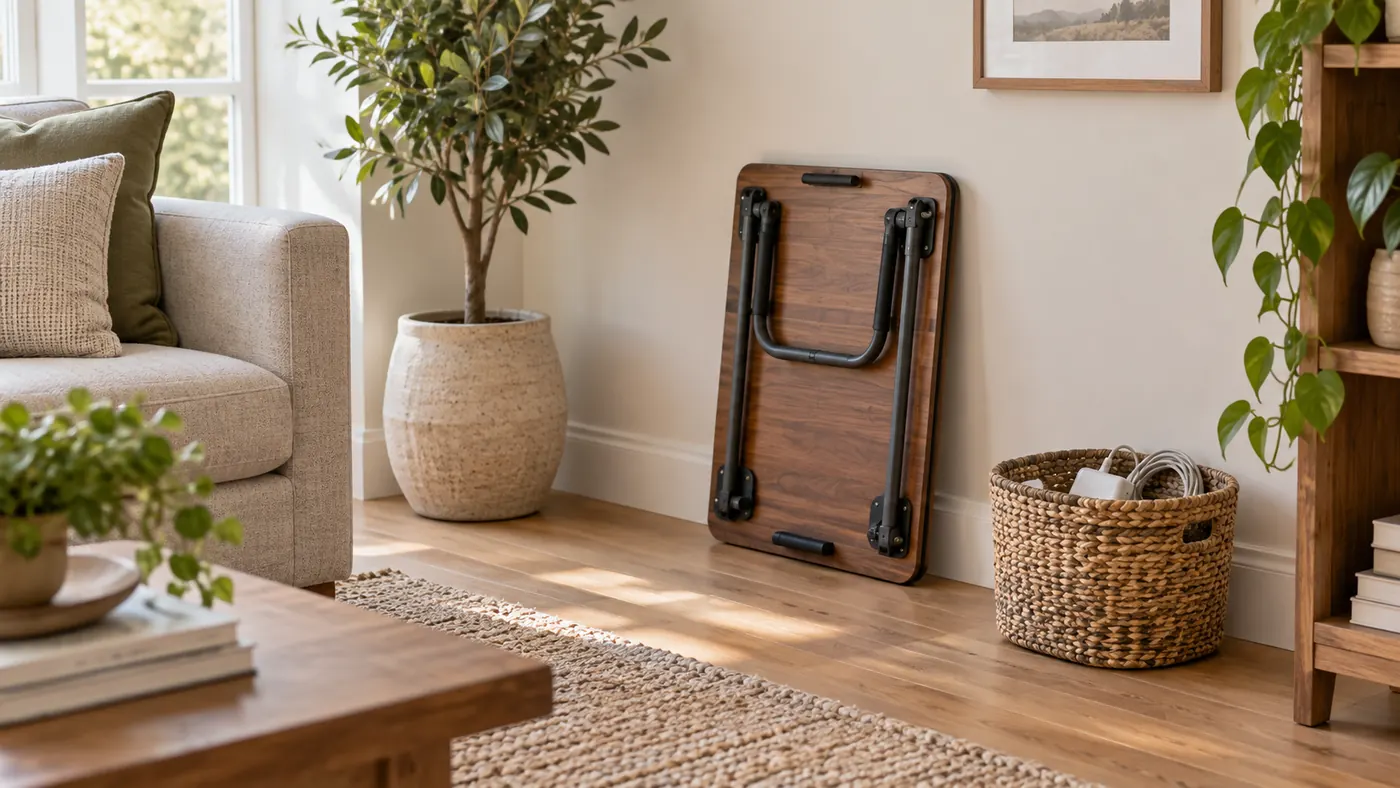
Design the reset before the first session
Give the desk a home position, cable path, and small accessory container before its first evening so departure does not rely on memory. Unplugging, folding, or rolling away should take less effort than leaving the work area assembled in front of the couch. Here, design the reset before the first session meets a distinct purpose: the useful desk is the one that supports a short focused session, then lets the room become a room again..
Use a short visual check before standing: laptop closed or stable, cable free of the feet, drink removed, and a path back to the room open. Store only the items that belong to this routine with the desk; unrelated papers turn a flexible surface into an unattended pile. If the desk is shared, label the routine through placement rather than signs: one basket, one outlet route, one resting position. The quiet success test is simple: after work, someone entering the room should see a living room rather than an abandoned workstation.
Run a room rehearsal
Before calling a setup finished, rehearse the ordinary sequence from the doorway. Bring the laptop to the desk, connect power, sit down, make one small height adjustment, reach for the item that usually lives beside the computer, and stand again. Repeat the sequence when a second person is in the room. This reveals whether the chosen side of the chair, the lamp, and the outlet agree with the idea of a portable workstation. It also exposes an important difference between a desk that fits and a desk that cooperates with the room.
Write down the two or three adjustments that actually mattered during the rehearsal. Perhaps the base needed to sit outside a rug edge, the screen needed a modest angle, or the cable needed to leave from the other side. Preserve those choices in the physical arrangement rather than relying on a memory of the first trial. A good home setup does not make a reader perform expertise at every use. It gives the next session an understandable starting point and makes an unsuccessful choice easy to revise.
Use the next week as evidence
A first setup can look persuasive simply because it is new. Give it several ordinary sessions: a bright afternoon, an evening with someone else using the room, a quick message check, and a longer reading block. Notice which choices stay effortless and which ones need a reminder. A desk that earns its place will become easier to position, not more elaborate. The observations may lead to a smaller surface, a different chair side, or a simpler accessory set; those are useful outcomes because they bring the setup closer to the room that actually exists.
A final practical filter
Keep the decision concrete. Put the chair in its usual position, use the ordinary outlet, and keep the objects that normally occupy the room in view. The desk does not need to win a comparison in the abstract. It needs to make one familiar sequence more orderly while leaving the floor, seat, and next activity easier to use afterward.
A short room check
- Map the chair, arms, footrest, and nearest walk route before comparing desk dimensions.
- Test the whole exit route with the desk in place, not only the surface at seated height.
- Set screen position before deciding whether a mouse, keyboard, or accessory really belongs on top.
- Keep ventilation, cables, and a clear standing path visible rather than hiding them under soft furnishings.
- Choose a storage and reset routine that restores the room after every session.
Keep the boundary honest
A portable desk is not a cure for a painful seating arrangement, nor a reason to work for hours in a reclined position that asks the wrists or neck to compensate. If the same discomfort appears across several setups, shorten the session, change the task, or use a more conventional workstation. This guide is about making a flexible setting more deliberate, not about declaring it universally ergonomic.
What I would carry forward
My final filter is reversibility. A useful portable laptop desk can be checked, positioned, and removed without a debate with the room. Choose the design that makes your own measurements, exit route, screen position, and reset routine easiest to repeat. That is more valuable than a feature that sounds impressive but never fits the couch you already have.
Continue through the independent archive
This notebook also keeps a transparent path to the preceding publication in the series. It covers a separate subject: planning conference-room speakers for large meeting spaces.
Compare a Dedicated Adjustable Seating Option
A laptop desk adapts a lounge seat; it does not reproduce an office chair’s adjustments. The next guide considers premium office chairs with synchronized tilt mechanisms for a dedicated workstation.